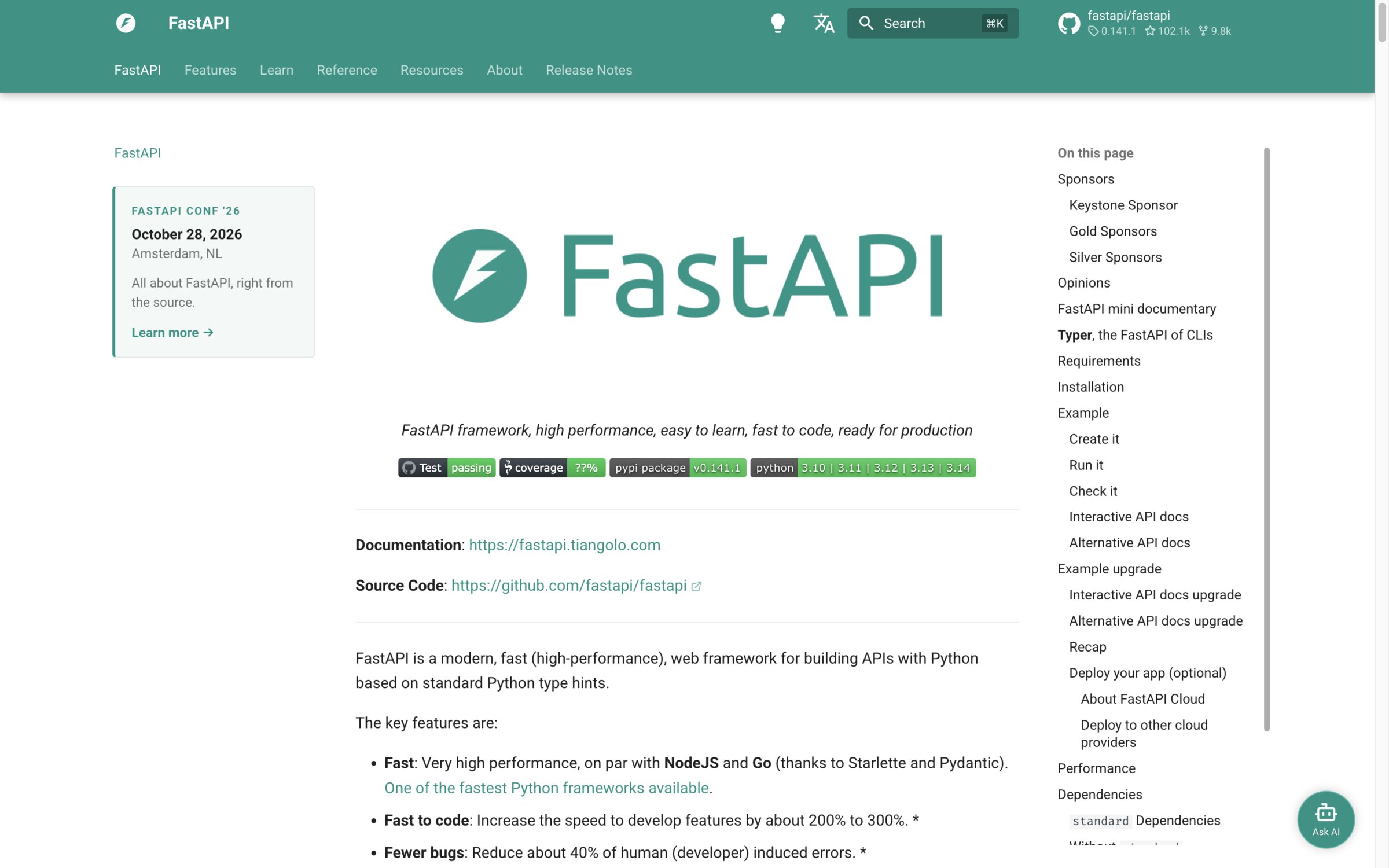
In this article I will explain what FastAPI is, why it displaced legacy Python web frameworks, and why it has become the default choice for modern Python web backends and AI services.
What is FastAPI?
FastAPI is a modern, high-performance web framework for building APIs with Python, based on standard Python type hints. It displaced legacy frameworks like Flask by offering native asynchronous support, automatic data validation, and auto-generated interactive documentation out of the box.
If you are building a new Python backend in 2026, FastAPI is the default choice. It combines the minimalism of micro-frameworks with the robust validation and concurrency required for modern web applications and AI inference endpoints.
FastAPI Origin
FastAPI was created by Sebastián Ramírez in late 2018. Before building it, he spent years working with various Python frameworks like Django, Flask, and APIStar. He found that none of them offered the perfect combination of automatic data validation, interactive documentation, and high performance.
After extensively studying the OpenAPI specification and JSON Schema, he realized he could build the ideal framework by combining Starlette for the web routing and Pydantic for data validation. He details this journey in his design history where he explains how previous tools inspired FastAPI.
The 3 Superpowers of FastAPI
FastAPI didn’t invent its core components from scratch. Instead, it brilliantly glued together two best-in-class libraries (Starlette and Pydantic) and added dependency injection and OpenAPI generation on top.
1. Starlette Under the Hood: Native Async Performance
At its core, FastAPI is built on Starlette, a lightweight ASGI (Asynchronous Server Gateway Interface) framework. This gives FastAPI native async/await event loops, allowing it to handle concurrent I/O-bound tasks (like database queries or external API calls) without blocking the main thread.
In independent benchmarks, FastAPI consistently delivers high throughput and low latency, matching or exceeding Node.js frameworks like Express. This makes it incredibly efficient for workloads that spend most of their time waiting on network requests or database operations.
2. Pydantic v2 Integration: Rust-Powered Validation
FastAPI uses Pydantic for data validation and serialization. You define the shape of your data using standard Python type hints, and FastAPI automatically validates incoming request payloads.
With the release of Pydantic v2, which features a core engine rewritten in Rust, validation is 5 to 50x faster for complex request bodies. If a client sends a string when an integer is expected, FastAPI automatically returns a structured 422 Unprocessable Entity error. This eliminates the need for manual if not isinstance(...) boilerplate, saving hours of debugging and ensuring strict type enforcement.
3. Automatic OpenAPI Docs
One of the most loved features of FastAPI is its zero-effort interactive documentation. Because you define your routes and models with type hints, FastAPI automatically generates an OpenAPI (formerly Swagger) schema.
By simply navigating to /docs or /redoc on your running server, you get a fully interactive web interface where developers can test endpoints directly from the browser. This eliminates the drift between your code and your API documentation. When the code changes, the docs update instantly.
FastAPI in Production: Real-World Use Cases
FastAPI is highly versatile and powers everything from simple microservices to complex enterprise systems. Here are the most common scenarios where I use it in production:
- AI Inference Endpoints: AI wrappers and LLM pipelines (like OpenAI or Claude integrations) involve heavy asynchronous network calls. FastAPI’s non-blocking architecture makes it perfect for streaming AI responses back to the client.
- Microservices: Its minimal footprint and fast startup times make it ideal for containerized microservices deployed on Docker or serverless environments.
- Background Task Dispatchers: FastAPI integrates seamlessly with task queues like Celery, ARQ, or Redis, allowing you to accept a request instantly and process heavy workloads in the background.
- SaaS CRUD Backends: With its strong typing and automatic validation, building robust Create, Read, Update, and Delete APIs for SaaS applications is faster and less error-prone than with older frameworks.
Dependency Injection Done Right
Dependency injection can often feel like an overly complex enterprise pattern, but FastAPI makes it elegant and Pythonic. You can declare dependencies in your route signatures, and FastAPI handles resolving and injecting them.
This system dramatically simplifies common backend tasks:
- Database Sessions: Automatically opening and closing database connections per request.
- Authentication Guards: Verifying JWT tokens or API keys before the route logic even runs.
- Configuration Loading: Injecting environment variables or settings into the endpoints that need them.
Because dependencies are just Python functions, they are incredibly easy to test. You can override them in your test suite to inject mock databases or fake authentication tokens without changing your core application code.
Need an experienced backend engineer to architect and build your FastAPI backend? I offer API development or Python development services tailored for startups and growing businesses.
Where to go next
- Modern REST API Development for Startups - Learn how to architect and build a high-speed REST API backend that scales.
- What Is an API? Architecture, Protocols, and Examples - A clear, visual explanation of how APIs work under the hood.
- React.js + FastAPI: The Perfect Stack for AI Web Apps - Why React and FastAPI are a practical, production-ready stack for AI web applications.