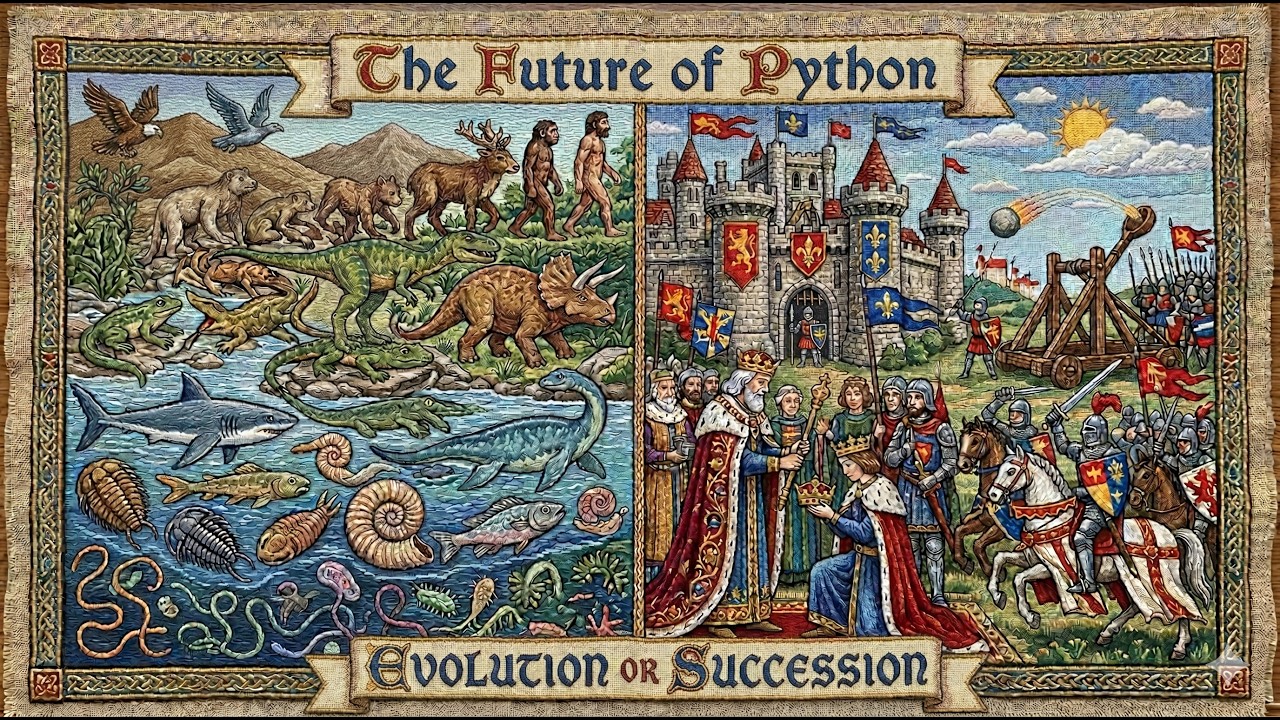
Watch the full PyCascades 2026 talk: The Future of Python: Evolution or Succession here
TL;DR:
- Programming languages don’t dominate because of superior syntax; they win by absorbing migrating user groups from dying ecosystems.
- Historically, programming languages last 10 to 25 years before a major succession event. At 35 years old, the current market leader, Python, is statistically overdue for replacement or radical evolution.
- The history of software is defined by community migrations—like Apple developers moving from BASIC to Pascal to C to Objective-C to Swift.
- The “100-year language” of the future will be whatever ecosystem can natively solve modern multi-core parallel computation while maintaining the easy “glue” capabilities that researchers and developers rely on today.
The Grand Tale of Evolution vs. Succession
If you look at the famous 2003 O’Reilly poster mapping the ancestry of programming languages, you see a family tree rooted in the 1950s with Fortran and Lisp. What this tree reveals is a constant cycle of cross-pollination, evolution, and death. CPL became BCPL, which became B, which ultimately became C.
History shows us that programming languages typically have a lifespan of 10 to 25 years before they face an existential crossroads. They either fundamentally evolve (like C to C++) or they experience a succession event, where a new language entirely takes over the ecosystem.
Today, Python sits at the top of the TIOBE index with a massive 21% market share. But at 35 years old, it is statistically overdue for a succession event. To understand what the next dominant programming language will look like, we have to stop looking at syntax and start looking at how user communities migrate.
The Myth of Syntax: It’s All About Migration
The most dangerous myth in software engineering is that the best technology wins. It doesn’t. The future of programming languages is dictated entirely by user group migrations.
We have seen these mass migrations time and time again:
- The Apple Ecosystem: Developers moved from writing BASIC on the Apple IIe, to Pascal, to C, to Objective-C for Mac OS X, and finally to Swift.
- The Web: The backend saw migrations from Perl to PHP, which was blown open by Ruby on Rails, which is now heavily contested by Node.js. On the frontend, JavaScript is actively evolving into TypeScript and WebAssembly.
When a language takes over the world, it is rarely because of computer science purity. In 2003, C dominated the market at 18%, while Python sat at a mere 1%. Today, those numbers have flipped. Why? Because the winning language acted as a sanctuary for orphaned communities.
When AI funding for Lisp dropped, researchers needed a new home. Peter Norvig, who literally wrote the book on building AI with Lisp, wrote a blog post in 2000 calling Python a “Lisp dialect.” When astronomers and physicists got tired of the friction of Fortran and the proprietary costs of MATLAB, they migrated to the open-source world.
The next great programming language won’t win because it has the cleanest paradigms. It will win because it acts as the perfect “glue”—capable of handling complex math while simultaneously wrangling messy system files and random lab tools, just like Python did for the refugees of Lisp, Fortran, and S.
The Pragmatic Compromises of Dominant Languages
When we look forward to the languages of the future, we should expect them to be built on pragmatic, sometimes ugly compromises that prioritize user psychology over academic perfection.
Even the most beloved features of current languages are often the result of human testing rather than compiler requirements. For instance, Python’s indentation-based blocking was borrowed from a teaching language called ABC. But the colon (:) at the end of statements was only added because actual user testing proved developers couldn’t understand the indentation without a visual cue to draw the eye.
Furthermore, dominant languages often rely on massive hacks to get by. Without a syntactic macro system or generic templating, modern features like Python’s data classes are actually implemented by eval-ing and executing code under the covers. The next dominant language will likely feature similar duct-tape solutions, because getting the job done is always more important to users than architectural purity.
The Hardware Wall: What the Next Language Must Solve
Succession events happen when a language hits an architectural wall it simply cannot evolve past. The architecture that made scripting great in the 1990s is actively hurting modern development in the 2020s.
For a new language to trigger a mass migration and succeed the current generation, it must solve four severe limitations:
- Straight-line performance: While current interpreted languages have doubled their execution speed over the last decade, they are still fundamentally slow compared to compiled languages.
- Parallel computation: As hardware scales horizontally, the inability to efficiently handle parallel computation across multiple cores (like Python’s struggle with the Global Interpreter Lock) is a fatal flaw.
- Type safety: Optional type systems are helpful for scripting, but massive enterprise codebases require strict, native safety guarantees.
- Extensibility: The lack of generic language extensibility forces core teams to maintain complex workarounds.
Right now, the industry bypasses these issues by writing the heavy computational lifting in C or Rust and wrapping it in a friendlier scripting language. But the moment a new language offers the performance of Rust with the frictionless “glue” capabilities of Python, a massive succession event will occur.
The Search for the “100-Year Language”
In his 2003 PyCon keynote, Paul Graham discussed the requirements for a “100-year language.” He predicted that even a century from now, we will still be telling computers what to do via recognizable programs rather than just describing human tasks to an AI.
What will that language be?
The future of programming relies entirely on the AI, data science, and systems engineering communities. If a new language emerges that natively solves the multi-core and performance issues of modern hardware while remaining incredibly easy to script with, those communities will migrate again.
The next era of software won’t be defined by who writes the perfect compiler. It will be defined by who builds the best sanctuary for the next generation of migrating developers.