Your competitor’s product now appears inside ChatGPT. Your CTO says you need an “MCP server.” Three Slack threads this week mentioned it like you already know what it is.
You googled it. You got JSON-RPC, transport layers, and a headache.
Here is the line nobody gave you: MCP is not a protocol. It is shelf space.
A shelf is simple physics. Products on the shelf get picked up. Products not on the shelf do not exist for the person standing in the aisle. The same is now true for AI assistants. When a user asks ChatGPT or Claude to do something, the AI reaches for what is on the shelf. If your product is not there, it reaches for your competitor’s.
Right now, the shelf is mostly empty.
The brands that claim their spot in 2026 become the defaults. The ones that do not will have to explain to their board, in 2027, why users found a competitor inside an AI they did not build.
In this article I will explain what an MCP server is, what shelf space means for your product, and how to decide if you need one, without writing a single line of code.
Shelf space instead of protocol
Most articles call MCP “USB-C for AI.” That is a cute comparison, but it is the wrong frame.
USB-C is about connection where one plug fits all ports. MCP is about placement where one shelf fits every store.
Before MCP, every AI tool was a separate store with its own shelving system. ChatGPT could not see your product. Claude could not touch your data. Cursor could not run your workflow. Each integration was a custom build for a single store. Engineers shipped one, then watched it break when the store remodeled.
So most teams did not bother. They stayed off the shelf entirely.
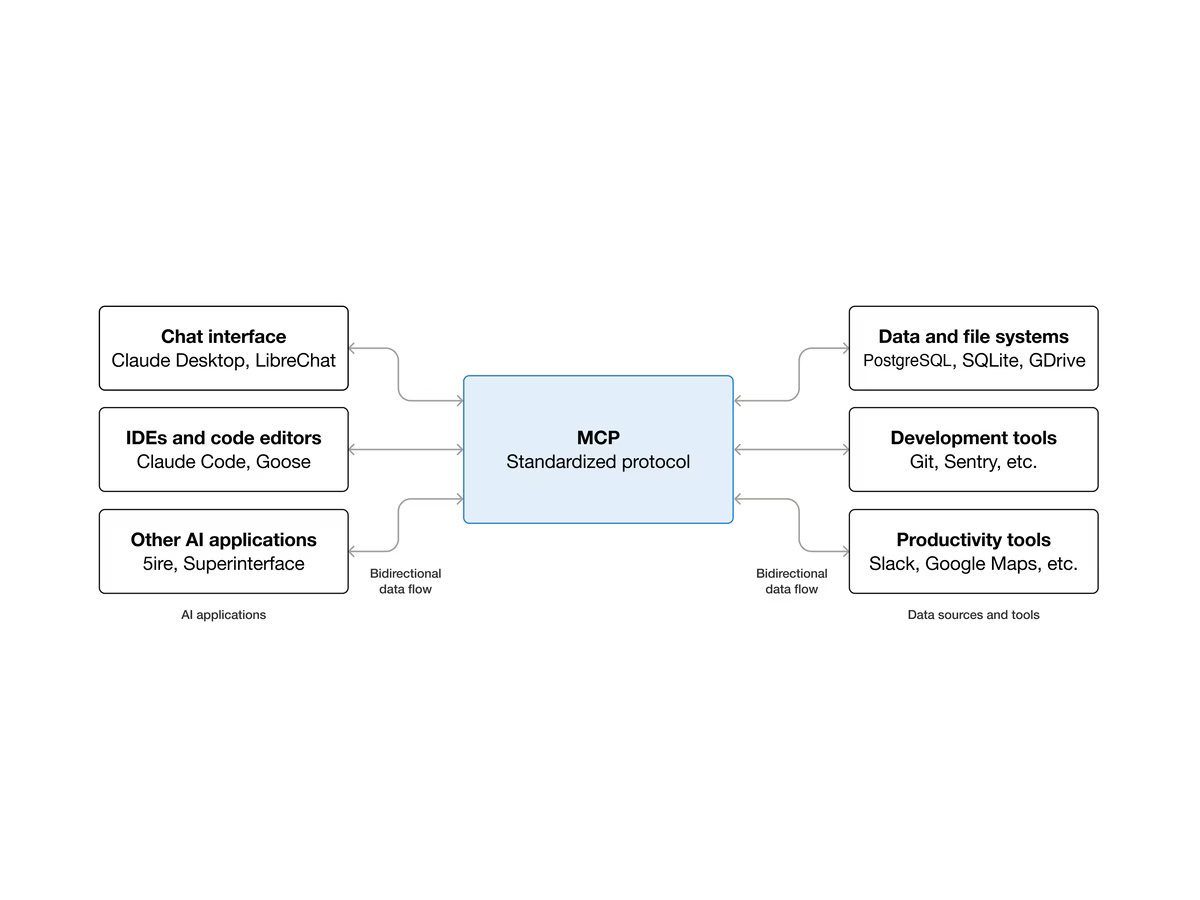
MCP changed the shelving. It is one standard. You build your product display once. It sits on every shelf like ChatGPT, Claude, Cursor, and the next tool nobody has launched yet. The AI tools reach for it, and your product responds.
This is not just another integration. This means your product is now reachable from inside the tools your customers already live in.
Your user does not open your dashboard. They ask Claude. Claude reaches for your product on the shelf. Your product responds.
That is placement that did not exist eighteen months ago. If your CTO frames this as a backend project, they are missing the point. Shelf space is market position, not engineering.
Three products on the shelf
Theory is cheap. Here is what shelf placement looks like for three real founder profiles.
The Airtable-first ops team
Old way: Your ops lead opens Airtable, finds the customer record, updates the status, copies the row into Slack, and summarizes it for the team. That is twelve clicks, eight times a day.
New way: Your ops lead asks Claude. Claude reaches for the Airtable MCP server that is already on the shelf. The record updates, and the summary lands in Slack. One sentence and zero clicks.
What you put on the shelf: A server that exposes your customers’ Airtable bases as something the AI can reach for safely.
The Slack-native SaaS
Old way: Your support agent is a separate app nobody opens. Customers forget it exists, and activation graphs look like a cliff.
New way: The agent is already on the shelf inside Slack, where your customers work. They mention it, it answers, it logs the ticket, and it pulls the data. Your product becomes ambient, always within reach, and never something they have to go find.
What you put on the shelf: A Slack MCP server that turns your tool into something the AI can hand to users mid-conversation.
The HubSpot CRM play
Old way: Your sales reps do not update the CRM. You know this. They know this. Your forecasts are fiction.
New way: A rep finishes a call and tells ChatGPT what happened. ChatGPT reaches for HubSpot on the shelf and writes the record. The CRM gets used because the rep never has to open it.
What you put on the shelf: A HubSpot MCP server that closes the gap between what happened and what is logged.
Notice the pattern. The product did not change. Its shelf placement did.
Three questions before you claim your spot
Do not build an MCP server just because the shelf exists. Build it because the answers below put you on it.
1. Are your users already standing in this aisle?
If yes, claim your shelf space. Every week you wait, another product fills the spot you could have taken.
If no, just watch. The shelf is not crowded yet. You have time to see how the aisle develops.
2. Do you have a product worth shelving?
If you have a clean API, an MCP server is a weekend project, not a quarter. Your engineers wrap it and place it.
If you do not, build the API first. Putting a broken product on the shelf does not fix the product. It just makes the breakage visible to every AI that reaches for it.
3. Does your product get stronger or weaker on an open shelf?
If your defensibility is the data, the shelf extends your advantage. More AIs reaching for your data means the same moat but with wider reach.
If your defensibility is the workflow, you should pause. A shelf makes your workflow visible and reachable by anyone. Sometimes commoditization is the price of placement. Sometimes the answer is not yet.
The shelf is filling up
AI assistants are becoming the new browsers. They are the place people go first before they go anywhere else.
In 2010, you needed a website or you did not exist. In 2018, you needed a mobile app or you were invisible. In 2026, you need shelf space inside the AI tools, or you are something the AI talks about instead of something it reaches for.
The shelf is getting crowded. Stripe claimed a spot. Linear claimed one. Notion, Sentry, Cloudflare, and GitHub all placed their products where the AI reaches.
Your category is next. The only question is whether your product is the one that gets pulled off the shelf, or the one that watches a competitor get pulled instead.
The protocol is the easy part. The decision to put your product on the shelf is not.
Need help getting your product shelf-ready? I build MCP servers and AI features for founders who would rather not turn placement into a six-month engineering project. Check out my custom software development services, or email me what you are building and I will reply with an honest scope.